May 29, 2026 • Callum Voss • 9 min reading time • Specs verified June 5, 2026
Ultrasonic Cleaning Solution Chemistry: Matching the Right Fluid to Your Parts and Machine
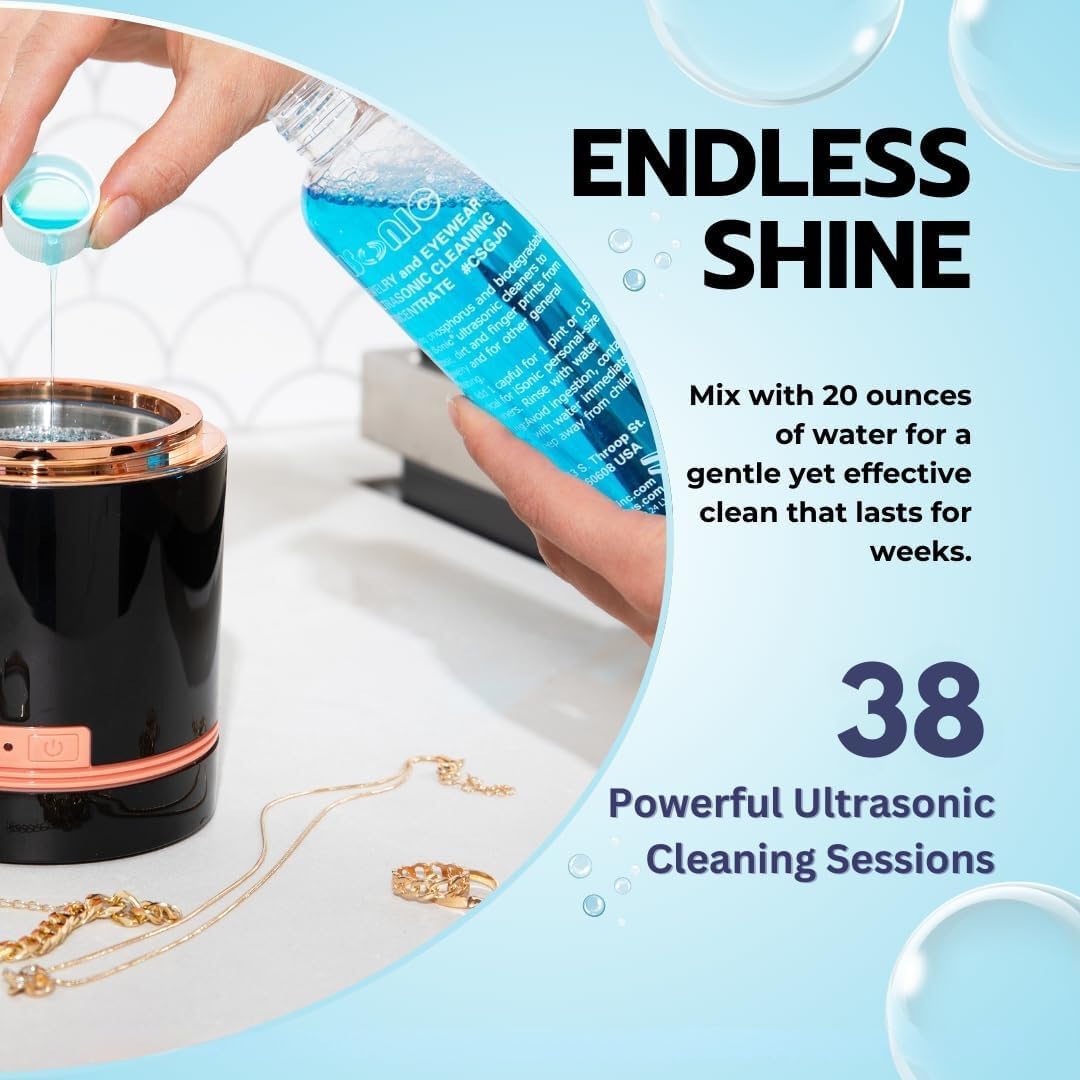
Ultrasonic cleaners work by generating microscopic bubbles in liquid that collapse violently against the surface of whatever you’re cleaning — a process called cavitation. The machine creates those bubbles; the cleaning solution (the fluid you fill the tank with) determines what contaminants actually lift off and whether your parts survive the process intact. Water alone will cavitate, but it won’t dissolve oils, flux residue, or mineral scale the way a purpose-formulated solution will. Get the chemistry wrong and you can etch aluminum, discolor gold plating, crack rubber seals, or corrode a PCB’s copper traces — even on a perfectly tuned machine. This guide is for practitioners who already understand their machine but want a disciplined framework for fluid selection: what’s in these solutions, how to match them to your substrate and contaminant, and where the real tradeoffs live.
What’s Actually in a Cleaning Solution (and Why It Matters)
Every ultrasonic cleaning solution is doing at least two jobs simultaneously: it has to support vigorous cavitation, and it has to chemically interact with the contaminant you’re trying to remove. Most commercial concentrates are built around three functional components.
Surfactants (surface-active agents) lower the surface tension of water, which both improves cavitation efficiency and helps contamination wet out and detach from a surface. The type and concentration of surfactant determines how aggressive the solution is and how much rinsing you’ll need afterward.
Builders and chelating agents — typically phosphates, EDTA, or citric acid-based compounds — attack mineral scale, oxidation, and ionic contamination by binding to metal ions and suspending them in solution. Alkaline builders are the workhorse of industrial applications. Chelators are common in precision applications like jewelry and PCB cleaning where controlled chemistry matters.
pH buffers hold the solution in the right range for your substrate. Alkaline solutions (pH 8–12) excel at cutting oil, grease, and carbon deposits. Neutral solutions (pH 6–8) are safer on sensitive metals and soft coatings. Acidic solutions (pH 3–6) dissolve oxides, rust, and mineral scale but are aggressive toward most metals if concentration or contact time isn’t controlled carefully.
Per Cole-Parmer’s ultrasonic solutions selection guide, concentration is not a “more is better” variable — over-concentrated solutions can actually suppress cavitation by damping bubble formation, and the chemistry becomes harder to rinse, leaving residue on precision parts.
Substrate-by-Substrate Decision Matrix
This is where most practitioners get into trouble. The machine’s frequency and power matter less than the chemical compatibility of your solution with what’s in the basket.
Jewelry and Precious Metals
Gold (solid, 14k–18k), platinum, and sterling silver tolerate a wide range of neutral to mildly alkaline solutions well. The standard recommendation from Branson’s BRANSONIC operations documentation is a neutral or low-alkaline commercial concentrate at 1–3% dilution, 40–50°C, for 3–5 minutes. The risk zone for jewelers is:
- Porous or filled stones — emeralds, opals, turquoise, and fracture-filled diamonds should not go into any ultrasonic, regardless of solution chemistry. Per Jewelers Mutual’s care guidance (Jewelers Mutual, “How to Clean Your Jewelry at Home”), these stones can crack from the cavitation itself.
- Rhodium-plated pieces — alkaline solutions above pH 9 accelerate plating wear. Neutral-pH concentrates designed for plated surfaces (Elma’s elma clean 65 or equivalent) are the correct call.
- Silver — mildly alkaline is fine, but solutions containing ammonia (common in older formulations) can temporarily brighten silver while accelerating tarnish over repeated cycles. Modern citric-acid-buffered concentrates avoid this problem.
Watch Components and Movements
The watchmaking community is where solution chemistry gets the most granular. A typical service cycle moves components through multiple solution stages: a degreaser pass, a rinse, sometimes a drying agent. The challenge is that a watch movement contains brass bridges, steel pinions, jeweled bearings, and sometimes fragile blued screws or black-polished surfaces — all in the same basket.
Operators in watchmaking forums (WatchUSeek’s technical service threads are a consistent reference point here) report that single-use commercial concentrates like L&R Ultrasonic #3 or Elma’s elma clean 10 neutral watch cleaning solution are preferred precisely because they’re pH-balanced for multi-metal environments. Avoid any alkaline solution above pH 9 on movements; brass and copper alloys develop surface discoloration rapidly at high pH with heat.
A note on IPA: Isopropyl alcohol (IPA) is sometimes used as a rinse stage in watch cleaning, not as a primary cleaning solution. It’s a poor primary cleaner in an ultrasonic because it flashes off, is a fire/explosion hazard in heated tanks, and cavitates poorly. Use it for a hand-rinse or final displacement step, not as tank fill.
PCB and Electronics Assemblies
This is arguably the highest-stakes application in this guide because the consequences of wrong chemistry aren’t always visible immediately — ionic contamination left on a board can cause field failures weeks later.
IPC-CH-65B (IPC’s guidelines for cleaning printed boards) explicitly establishes that the cleaning solution must be matched to the flux chemistry used in soldering. Water-soluble flux (OA flux) responds well to deionized water with a small amount of ionic-contamination-rated surfactant. No-clean flux, counterintuitively, often requires a more aggressive saponifier-based chemistry to fully activate and remove the residue — “no-clean” means it’s safe to leave if you don’t clean it, not that it cleans easily with water.
The key spec to look for: solutions certified to IPC standards for ionic contamination will state a residual ion level (typically measured in µg NaCl equivalent per cm²). For high-reliability assemblies, this number needs to be below 1.56 µg/cm². This is a published spec distinction, not a marketing claim — and it narrows the field considerably.
Avoid alkaline solutions above pH 10 on boards with aluminum heat sinks or bare copper pads; the copper will oxidize. Avoid any solution with chlorinated solvents unless you have the ventilation infrastructure and disposal protocols to match.
Industrial Parts: Steel, Aluminum, and Cast Iron
Machine shops and firearms cleaning operations typically deal with heavy grease, carbon, and metal fines. Here, alkaline solutions (pH 9–11) are the standard, and concentration can run higher (3–10%) because substrate sensitivity is lower.
The critical split:
- Aluminum and its alloys — strongly alkaline solutions (pH > 11) will etch aluminum. Crest Ultrasonics’ cleaning solutions guide explicitly calls out that aluminum-compatible solutions should target pH 8.5–10 and include inhibitors like sodium silicate or sodium gluconate.
- Ferrous parts (steel, cast iron) — standard alkaline degreasers work well, but ferrous parts need either a rust-inhibiting additive in solution or an immediate post-clean dry and oil step. The ultrasonic process removes the protective oxide layer; unprotected ferrous parts will flash-rust in minutes.
By the Numbers: Common Solution Categories at a Glance
| Application | Recommended pH Range | Typical Concentration | Temperature |
|---|---|---|---|
| Jewelry (gold, platinum) | 7–9 | 1–3% | 40–60°C |
| Watch movements | 6–8 | per manufacturer | 35–45°C |
| PCBs (water-soluble flux) | 7–9 | 2–5% | 40–55°C |
| Industrial steel/carbon | 9–11 | 3–10% | 50–70°C |
| Aluminum parts | 8–10 (inhibited) | 3–8% | 40–60°C |
Solution Management: Concentration, Temperature, and Change Intervals
This is where most mid-tier operators leave performance on the table. The solution is a consumable with a service life, and running degraded chemistry is the single most common cause of “my machine isn’t cleaning as well as it used to” complaints.
Concentration drift: Ultrasonic tanks lose water to evaporation, which means concentration rises over a shift. Top up with water (not fresh concentrate) to maintain your target dilution. For operations running 6–8 hours/day, Crest’s application notes recommend measuring with a conductivity meter or refractometer (for surfactant-based solutions) rather than guessing.
Contamination loading: Solution degrades as it accumulates the contamination it’s removing. A good rule of thumb from aggregated operator reports: when the solution is visually turbid or when cleaning time has to increase by 30%+ to hit the same result, it’s time to change. For professional jewelry shops running heavy volume, this can be daily. For occasional PCB cleaning, it may be weekly.
Temperature interaction: Higher temperature generally improves cleaning rate and reduces required time — but it also accelerates chemical degradation of the solution. Running a tank at 70°C for extended periods depletes your chemistry faster and can break down certain surfactant types. Elma’s technical data sheets for their elma clean series specify maximum continuous operating temperatures for each formulation; these are worth reading before assuming hotter is always better.
Rinsing is not optional. Even the mildest surfactant-based solution will leave a residue on precision parts if rinsing is skipped. For watch parts and PCBs, a two-stage rinse (a dilute rinse tank followed by a deionized water rinse) is the minimum standard. For jewelry, a fresh warm water rinse and ultrasonic pass is common practice.
Decision Rules: If X, Then Y
If you’re reading this with a current purchasing or process decision in front of you, here’s the plain-language version:
If your parts are mixed metals (watches, jewelry with stones set in metal, mechanical assemblies), default to a neutral pH (6.5–8) concentrate rated for multi-metal use. Do not assume a higher-pH industrial degreaser will “work fine” because it seems mild — brass and plating respond differently than steel.
If you’re cleaning PCBs for any reliability-critical application, the solution must match the flux type and carry an ionic contamination spec. Generic industrial degreasers are not an acceptable substitute. IPC-CH-65B is the standard to cite when your customer or quality system asks why.
If you’re cleaning aluminum parts, check the solution’s inhibitor chemistry explicitly. Alkaline solutions without silicate or gluconate inhibitors will etch aluminum surfaces and are not reversible. This is the most common operator error in machine shop applications, per aggregated operator reports on Cole-Parmer’s product Q&A threads.
If you’re scaling from a single tank to a multi-tank line, the chemistry decision and the tank sequencing (clean → rinse → rinse → dry) should be decided together, not sequentially. A good cleaning chemistry paired with an inadequate rinse stage produces contaminated “clean” parts.
If you’re ever unsure whether a solution is compatible with a substrate, the lowest-risk path is to contact the solution manufacturer with the substrate list and ask for a written compatibility confirmation. This is standard practice for commercial operations and should be standard for prosumer-level work on irreplaceable parts.
The machine does the mechanical work. The chemistry does the chemical work. Respecting that division — and selecting each independently for your specific application — is what separates repeatable, professional-grade results from the frustrating hit-or-miss experience that sends people back to manual cleaning.