April 6, 2026 • Callum Voss • 9 min reading time • Specs verified June 5, 2026
Desktop Ultrasonic Cleaners for Watchmakers and Jewelers: Heater, Degas, and Sweep Features Worth Paying For
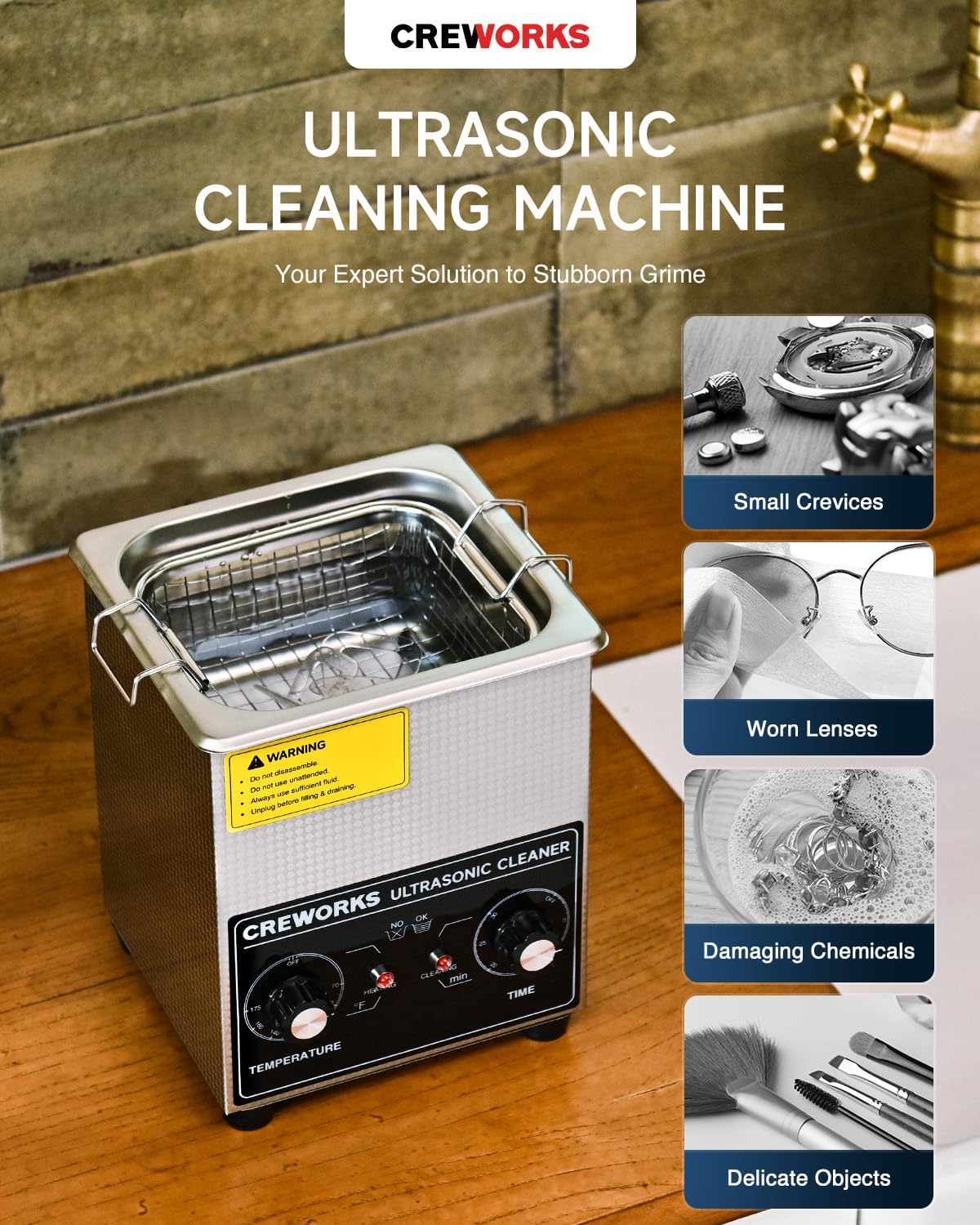
An ultrasonic cleaner works by sending high-frequency sound waves — typically between 28,000 and 80,000 cycles per second — through a liquid-filled tank. Those waves create millions of microscopic bubbles that implode violently against the surface of whatever you’ve submerged. The result is a scrubbing action that gets into spaces no brush or cloth ever could: the pivot holes of a watch movement, the prong seats of a diamond setting, the underside of a coin bezel. For watchmakers and jewelers, this is the tool that separates a truly clean part from one that just looks clean under regular light. This guide is aimed at practitioners who already know what an ultrasonic cleaner is and are now making a real purchasing decision — evaluating units in the $150–$800 range and trying to figure out which features on the spec sheet justify a higher price tag and which are marketing noise.
| EDITOR'S PICK[VEVOR 6L Sonic Cleaner](https://www.amazon.com/dp/B01HGNYO0U?tag=greenflower20-20) with Hea… | Mid-tierCREWORKS Ultrasonic Cleaner wit… | Budget pick[CREWORKS 2L Ultrasonic Cleaner](https://www.amazon.com/dp/B075FTFD3R?tag=greenflower20-20)… | |
|---|---|---|---|
| Capacity | 6L | 2L | 2L |
| Power | 180W | 60W | 60W |
| Degas Mode | — | ✓ | ✓ |
| Gentle Mode | — | ✓ | ✓ |
| Basket Included | ✓ | — | — |
| Price | $89.90 | $56.98 | $49.76 |
| See on Amazon → | See on Amazon → | See on Amazon → |
The Three Features That Actually Move the Needle
Mid-tier desktop units — think iSonic P4820/P4830, Branson BRANSONIC M-series, and Elma xtra ST line — separate themselves from cheap single-knob tanks primarily through three feature sets: integrated heating, sweep mode, and degassing. Every marketing page lists them. Almost none of them explain when they matter. Here’s the honest breakdown.
Integrated Heating
Heat accelerates the cavitation process — the bubble-formation mechanism described above — and it makes most cleaning solutions chemically more active. The practical upshot for jewelers: a solution held at 50–60°C will dissolve polishing compound, skin oils, and flux residue faster and more completely than the same solution at room temperature.
But the gains are not linear and not free. Published spec sheets from iSonic put their P4820 heater at a maximum of 80°C, while Elma’s xtra ST series rates their tanks across a 20–80°C range with a digital PID controller (a type of temperature regulator that actively corrects for drift rather than just switching a heating element on and off). That distinction matters in practice. A simple on/off heater can overshoot — particularly in a small-volume tank — causing localized hot spots that can stress certain adhesives in watch crystals or affect heat-sensitive gemstone treatments like fracture-filling in emeralds.
If X, then Y — heating decision rule:
- If you’re cleaning bare metal parts (movements, cases, tool steel), a basic heater is fine. Run it at 40–50°C and call it done.
- If you’re cleaning set stones, treated gems, or vintage parts with adhesive-bonded components, you want temperature precision — a digital PID controller — not just a heat lamp with a dial. That means stepping up to the Elma or Branson M-series tier, which adds roughly $150–$300 over a plain-heater iSonic.
Sweep Mode
Here’s the one that gets under-explained the most. A fixed-frequency ultrasonic cleaner operates at exactly one frequency — say, 40 kHz — all the time. The problem is that standing waves (zones of peak energy and near-zero energy, like nodes on a vibrating guitar string) form in the tank at that fixed frequency. Parts sitting in a low-energy node get cleaned poorly. Parts sitting at a high-energy antinode get over-cavitated and can develop surface pitting on soft metals — gold fills, softer silver alloys, plated surfaces.
Sweep mode (sometimes called “frequency sweep” or “wobble mode”) continuously modulates the operating frequency across a narrow band — typically ±2–5 kHz around the nominal frequency. This breaks up standing waves, distributes energy more evenly across the tank, and reduces the risk of localized over-cleaning. Community threads on WatchUSeek consistently identify sweep mode as the feature most appreciated after purchase by working watchmakers — particularly those cleaning complete movement blanks or multi-part batches in a single run.
Not every manufacturer implements sweep the same way. The Branson BRANSONIC M-series technical documentation describes their sweep as a continuous ±3 kHz modulation. The iSonic P4830 (their step-up commercial unit) includes a sweep function that owners report as noticeably more uniform in cleaning distribution than the fixed-frequency P4820. The Crest CP series, per Crest’s own product documentation, ships sweep as standard across their mid-tier desktop line.
The tradeoff: Sweep adds approximately $80–$200 to the unit cost at this tier. If you’re running a high-volume bench — cleaning 20+ movements or settings per day — the investment is easy to justify on quality consistency alone. If you’re doing occasional piece work, a fixed-frequency unit with good basket positioning (keeping parts off the center-bottom sweet spot) gets you most of the way there.
Degassing
Degassing is the process of driving dissolved air out of the cleaning solution before (or at the start of) a cleaning cycle. Fresh solution — and even solution that’s been sitting — contains dissolved gases that dampen cavitation. Bubbles that would otherwise implode energetically get absorbed or cushioned by that dissolved gas. The result is a less effective first cycle.
A unit with a dedicated degas mode (found on Elma xtra ST, Branson M-series, and Crest CP commercial units) runs at high power for a set period to expel dissolved gas before switching to normal cleaning mode. The practical improvement is most noticeable with fresh solution changes. After solution is broken in (typically after 10–20 minutes of operation), the degassing advantage diminishes — the solution has already outgassed.
For most working jewelers and watchmakers, this means degassing matters most if you:
- Change your solution frequently (every shift, or multiple times per day)
- Use ammonia-based or enzyme cleaning solutions that outgas more readily than simple detergent solutions
- Are cleaning parts with complex geometries where even moderate cavitation suppression leaves residue in tight tolerances
If you change solution weekly or less often and do single-part runs, degassing is a real but marginal benefit. It’s not worth paying $200 more purely for degas if the rest of your workflow doesn’t demand it.
Frequency Choice: 28 kHz vs. 40 kHz for Bench Work
This decision gets conflated with feature discussions, so it’s worth isolating. Frequency is not a feature — it’s a design parameter of the transducer hardware, and it determines the character of cleaning action you get.
By the numbers:
| Frequency | Bubble size | Energy per bubble | Best for |
|---|---|---|---|
| 28 kHz | Larger | Higher | Heavy contamination, robust metals |
| 40 kHz | Medium | Moderate | General jewelry, steel cases, tools |
| 80 kHz | Smaller | Lower | Delicate surfaces, plated parts, fine settings |
For general-purpose watch and jewelry cleaning, 40 kHz is the reliable default. The Cole-Parmer ultrasonic cleaner selection guide specifically positions 40 kHz as the “general purpose” frequency for precision parts cleaning, with 80 kHz recommended when substrate damage risk is a primary concern.
The practical implication: if your shop handles a mixed workload — steel tool components, gold cases, set stone jewelry — a 40 kHz unit with sweep mode covers 85% of your work without compromise. A 28 kHz unit is overkill for delicate settings. An 80 kHz unit is underpowered for heavily soiled machine shop-adjacent work. The exception is a dedicated delicate-parts station for high-value set pieces, where the case for 80 kHz (or a dual-frequency unit) is legitimate.
The Honest Price-to-Value Map at This Tier
Here’s how the features stack up across price bands as of mid-2026:
$150–$300 range (iSonic P4820 and comparables): Heater is present. Fixed frequency. No sweep. No degas. Adequate for occasional cleaning of robust parts. Owners report consistent results on bare metal movements and unset pieces. For a watchmaker doing side work, this is a defensible starting point — not a forever tool.
$300–$600 range (iSonic P4830, Branson M-series lower end, Elma entry xtra ST): This is the decision-dense tier. Sweep appears here. Digital temperature control appears here. Published specs from Branson’s M-series documentation confirm sweep and adjustable frequency at this price band. Elma’s xtra ST ships with a digital display and PID-style control beginning in the mid-$300s (for smaller tank volumes). This is where most working single-bench jewelers and watchmakers should land.
$600–$1,200 range (Crest CP series, Elma xtra ST larger tanks, Branson M-series upper end): Degas is standard. Larger tank volumes (3–6L range). Better transducer build quality. Crest’s CP series documentation rates their transducers for continuous commercial-duty operation — a meaningful specification if your cleaner is running 6+ hours per day. Per Grainger’s industrial cleaner listings, units in this band frequently carry NRTL safety certifications and longer warranty terms, which matter for shop insurance documentation.
Decision Rules: Matching Features to Your Actual Workflow
The point of this guide is to give you a clean if/then frame for the purchase decision you’re actually sitting on.
If you’re a solo watchmaker doing 5–15 movements per week: Get a 40 kHz unit with sweep and a basic digital heater in the $300–$450 range. The iSonic P4830 or entry Branson M-series covers this. Skip degas unless you’re changing solution more than twice per week.
If you’re a bench jeweler with a mixed workload (set stones, bare metal, plated findings): Prioritize sweep over degas. Get a unit with temperature control that reaches at least 60°C with a PID or equivalent controller. The Elma xtra ST in the mid-tank volume (1.5–3L) range is well-suited here based on published specs and the frequency of positive operator feedback documented in trade-adjacent community discussions.
If you’re running a two-bench or small studio operation with continuous daily use: Step up to the Crest CP series or upper Branson M-series. The duty-cycle rating and transducer longevity specs justify the price difference over a multi-year horizon. Degas becomes genuinely useful at this volume because you’re changing solution on a regular schedule. At this tier, Grainger and Cole-Parmer are legitimate sourcing channels with documented pricing transparency.
If you’re evaluating a used Branson or Crest unit: The used market for professional-grade ultrasonic cleaners is active and worth navigating. Transducer output can be checked with a simple foil test — a thin aluminum foil sheet submerged for 30–60 seconds should show an even pattern of small holes across its surface, indicating uniform cavitation distribution. Uneven pitting or bare patches suggest a failing or failed transducer. This is a documented field evaluation technique referenced in Branson’s own service documentation for the M-series line. Factor in transducer replacement cost ($100–$300 depending on unit) when calculating effective purchase price.
The takeaway across all of this: heater and sweep are the features most likely to change your day-to-day results. Degas is valuable but situational. Frequency is a foundational choice, not an upgrade. Buy the smallest tank that realistically fits your largest common part with clearance — tank volume drives footprint and solution cost more than most buyers anticipate before their first purchase.