April 21, 2026 • Callum Voss • 9 min reading time • Specs verified June 5, 2026
10L to 37L Ultrasonic Cleaners for Carburetors, Engine Parts, and Shop Use: Wattage and Tank Volume Tradeoffs
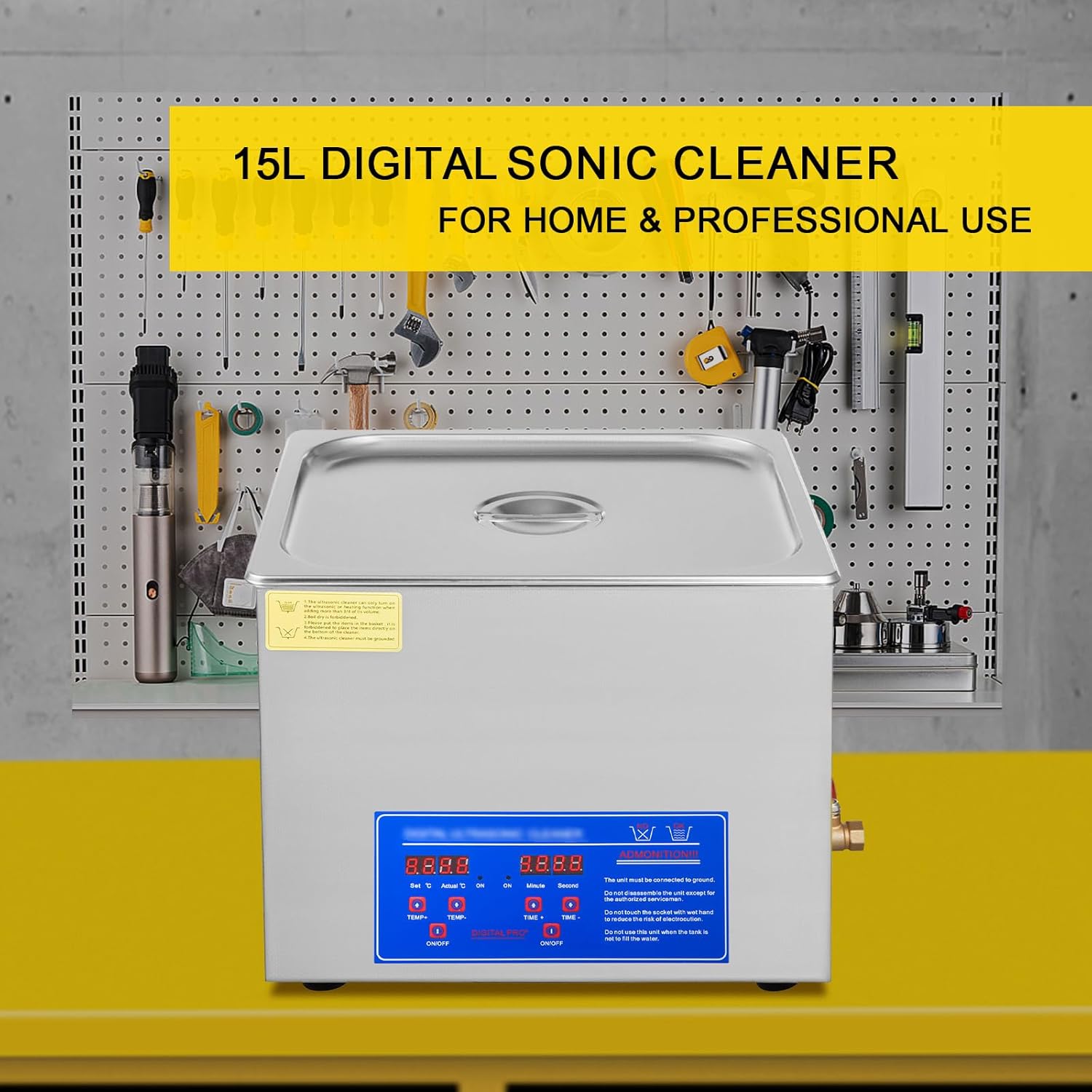
If you’ve ever tried cleaning a carburetor by hand — soaking it in a parts-washing bucket, digging at every jet passage with a wire brush — you already know the frustration. Tiny fuel passages, pressed-in check valves, and varnished float chambers don’t yield to brushes and solvent alone. An ultrasonic cleaner solves this by sending high-frequency sound waves (typically 28,000–40,000 vibrations per second) through a liquid-filled tank. Those waves create and collapse millions of microscopic bubbles in a process called cavitation, and the scrubbing action of those collapsing bubbles reaches every blind hole and recessed surface a brush can’t touch.
For jewelry or eyeglasses, a 2-liter desktop unit is plenty. For carburetors, small-block engine heads, transmission valve bodies, firearms components, and general shop cleaning, you need something in the 10-liter to 37-liter range — large enough to submerge the part with room to spare, powerful enough to drive cavitation through a loaded tank of heated solution. This guide walks through the wattage-to-volume relationship that determines whether a unit actually cleans or just vibrates expensively, then maps those specs to the parts and budgets you’re most likely working with.
| EDITOR'S PICK[DK SONIC Ultrasonic Cleaner 30L](https://www.amazon.com/dp/B0DP2F7P3H?tag=greenflower20-20) | Mid-tier[VEVOR 15L Ultrasonic Cleaner wi…](https://www.amazon.com/dp/B0FRZR39T2?tag=greenflower20-20) | Budget pick[VEVOR 10L Sonic Gun Cleaner](https://www.amazon.com/dp/B0DK8TPSC9?tag=greenflower20-20) | |
|---|---|---|---|
| Capacity | 30L | 15L | 10L |
| Power | 600W | — | 300W |
| Frequency | — | 40kHz | 40kHz |
| Basket | ✓ | — | ✓ |
| Price | $459.99 | $138.90 | $119.90 |
| See on Amazon → | See on Amazon → | See on Amazon → |
Why Tank Volume and Wattage Are Inseparable
Here’s the trap most first-time large-tank buyers fall into: they buy on volume alone, then wonder why cleaning results are mediocre. A 30-liter tank running 300 watts of ultrasonic power is, for most automotive work, an underpowered unit. The volume is right but the energy density is wrong.
The working benchmark is watts-per-liter (W/L) of ultrasonic output power — not the total electrical wattage, which includes heater draw. Published ultrasonic output power and rated electrical input are different numbers. Crest Ultrasonics’ CP Series documentation distinguishes these explicitly, noting that ultrasonic output is typically 40–60% of total electrical input on units where the heater rating is bundled into the headline figure. Always confirm which number is being advertised.
For light-contamination work — degreasing aluminum carb bodies, cleaning disassembled parts — a minimum of 10 W/L of ultrasonic output gets the job done. For heavy-carbon deposits, baked-on gasket material, or blind passages clogged with varnish, 15–20 W/L is where operators consistently report the difference between “good” and “actually finished in one cycle.”
By the numbers:
| Tank Size | Minimum Useful Ultrasonic Output | Target Output for Heavy Shop Work |
|---|---|---|
| 10L | 100W | 150–200W |
| 20L | 200W | 300–400W |
| 30L | 300W | 450–600W |
| 37L | 370W | 550–740W |
These are ultrasonic output watts, not heater or total electrical ratings. Cole-Parmer’s ultrasonic cleaner selection guide uses a similar density framework when recommending units for industrial degreasing applications.
The 10–15L Range: Carburetors, Valve Bodies, and Disassembled Parts
A 10–15 liter tank is the practical workhorse for most one- and two-barrel carburetor work, motorcycle carb rebuilds, small valve bodies, fuel injectors, and disassembled fastener sets. The tank footprint is manageable on a workbench, solution changeover is relatively economical, and at this volume the available wattage options cover the full range from marginal to excellent.
What fits: A Rochester Quadrajet disassembled into its major castings, or a pair of SU carburetors, or a complete motorcycle carb bank from an inline-four — these are comfortable in a 10L tank with basket clearance. A fully assembled Holley four-barrel is borderline at 10L; the spread of the main body plus fuel bowls eats your clearance fast.
Tank clearance is not optional. Elma’s xtra ST series documentation notes that effective cavitation requires a minimum 25–30mm of liquid between the part surface and the tank wall or floor — parts resting directly on the basket bottom significantly reduce cleaning efficiency on the contact faces. Factor this into your usable interior dimensions, not just stated tank volume.
Frequency: Most units in this class ship at 40 kHz. That’s appropriate for carburetor work — fine enough to penetrate small passages, energetic enough to move varnish and light carbon. If you’re also cleaning injector nozzles or precision metering parts, a unit with a 80 kHz mode or a dual-frequency option from the Branson BRANSONIC line gives you flexibility, though for pure carburetor work it’s not necessary.
Heater: Non-negotiable at this task level. Most shop-grade solutions (alkaline degreaser concentrates, dedicated carb-safe aqueous solutions) activate at 50–65°C. A unit without a heater, or with a heater capped below 60°C, limits your chemistry options and extends your cycle times significantly. Branson’s BRANSONIC technical bulletin on benchtop units confirms that heated operation at 55–65°C typically cuts cycle time by 30–50% compared to ambient-temperature operation for aqueous degreasing.
Degas feature: Worth having if you’re running fresh chemistry frequently. A degas cycle drives dissolved air out of solution before cleaning begins — dissolved air cushions cavitation bubbles and measurably reduces cleaning intensity. Grainger’s ultrasonic cleaner product category overview notes that degas functionality is a common differentiator in the $400–$800 unit tier, where shop buyers are most price-sensitive.
The 20–37L Range: Full Carburetors, Intakes, Heads, and Batch Work
Once you move into the 20L+ bracket, you’re in the territory of assembled carburetor bodies, intake manifold sections, cylinder head ports, transmission housings, and multi-part batch cleaning for a production shop. This is also where the wattage math becomes the deciding variable more than brand preference.
What fits in 20L: An assembled Holley 4150 with plenty of clearance, a single-plane intake manifold section, or a batch of injectors plus throttle bodies from a V8. A two-barrel manifold from most domestic V8 applications is workable; a full-length dual-plane intake manifold is tight and may need partial submersion in sequence.
What justifies 30–37L: Full motorcycle cylinder heads, automotive small-block heads run as a unit (disassembled from block), commercial carburetor overhaul shops processing multiple units per day, and machine shops cleaning precision-machined castings before inspection. Crest’s CP Series documentation for their larger-format units specifically targets these batch-production scenarios, noting that continuous-duty cycle ratings become the relevant spec at this size — a unit rated for 30-minute maximum cycles doesn’t serve a shop running eight hours a day.
Duty cycle: This is the most underread spec in the large-tank category. Consumer-adjacent units may be rated for 20–30 minute cycles with cool-down periods. Commercial units from Crest, Elma, and Cole-Parmer in the $1,500–$4,000 range are typically rated for continuous or near-continuous operation. If you’re running more than three to four cycles per day, confirm the duty cycle rating before purchase — running an underpowered consumer unit continuously will shorten transducer life significantly.
Sweep / frequency modulation: At 20L+, sweep becomes more useful than in smaller tanks. Sweep modulates the frequency slightly (±2–5%) to prevent standing waves — zones within the tank where cavitation activity is uneven. In large tanks, standing waves create dead spots where parts in those positions clean poorly. Units from the Elma xtra ST line and Crest CP series include sweep as standard in their commercial-format configurations. It’s not a premium feature at this size; it’s a baseline requirement.
Solution chemistry at scale: A 37-liter tank uses 30–33 liters of working solution (accounting for part displacement and clearance). At typical dilution ratios for alkaline degreasing concentrate (1:10 to 1:20), you’re managing a real consumable cost. Operators in long-run reviews on commercial parts-cleaning forums note that solution life varies dramatically based on contamination load — a lightly soiled batch of carb bodies might allow four to six tank loads before solution change, while a batch of heavily varnished units may require a change after two loads. Budget solution turnover into your operating cost before choosing tank size.
Matching Budget to Use Case: If X, Then Y
The decision matrix for large-tank ultrasonic purchases is cleaner than the spec-sheet noise suggests. Here’s where the tradeoffs land honestly:
If you’re running a one-bay shop or home garage and cleaning one to three carburetors per week: A 10–12L unit with 150–200W of confirmed ultrasonic output, a heater to 60°C+, and a degas function covers 90% of what you’ll encounter. Budget range in the current market is approximately $350–$700 for a unit meeting these specs from established brands. Units from iSonic’s industrial line or entry-level Crest configurations land here. This is not a compromise tier — it’s appropriately sized, and an undersized 20L unit with weak wattage will clean worse than a well-specified 10L.
If you’re running a motorcycle shop, small engine rebuilder, or volume carb rebuilder processing five or more units per day: Step up to 20L with 300–400W of confirmed ultrasonic output, a continuous duty cycle rating, sweep, and industrial-grade stainless construction. Budget $900–$2,000. Crest CP series and Elma xtra ST configurations in this tier are where commercial-adjacent buyers consistently land. Cole-Parmer’s catalog lists comparable units at Grainger-stocked price points in the $1,200–$1,800 range for this output class.
If you’re a machine shop, dealership service department, or production facility cleaning heads, housings, and precision castings daily: 30L+ with 500W+ ultrasonic output, continuous duty, sweep, and industrial chemistry compatibility is the right frame. Budget $2,000–$5,000 for units that will run reliably at production volume. At this tier, the procurement conversation should include transducer warranty terms (three to five years is reasonable for commercial units), the availability of local service, and chemistry compatibility documentation for the alloys and coatings in your work stream.
One tradeoff to name explicitly: Bigger is not safer when wattage doesn’t scale with volume. A 30L unit at 200W ultrasonic output will clean more slowly and less thoroughly than a 15L unit at 300W for the same parts. If a seller is leading with tank volume and obscuring the output wattage, that’s the signal to press harder on the spec sheet or look elsewhere.
On frequency for automotive work: 28 kHz is the right choice for heavy-carbon and baked-on deposit removal — lower frequency generates larger, more energetic cavitation bubbles. 40 kHz is appropriate for carburetor work and precision parts where aggressive cavitation could damage soft alloys or delicate machined surfaces. Unless you’re also cleaning electronics or fine jewelry in the same unit, a dedicated 28 kHz large-tank system is the optimized choice for pure shop use. Per Crest Ultrasonics’ CP Series application guide, 28 kHz configurations are explicitly recommended for heavy-duty degreasing and carbon removal in automotive and industrial contexts.
The math isn’t glamorous, but it’s reliable: confirm ultrasonic output watts, divide by tank volume, target 15–20 W/L for serious work, and match duty cycle to your actual daily volume. Everything else — brand preference, control panel features, build quality — falls into place around those two numbers.