April 20, 2026 • Callum Voss • 8 min reading time • Specs verified June 5, 2026
Under $50 Ultrasonic Cleaners for Jewelry and Eyeglasses: Frequency and Tank Size Tradeoffs Explained
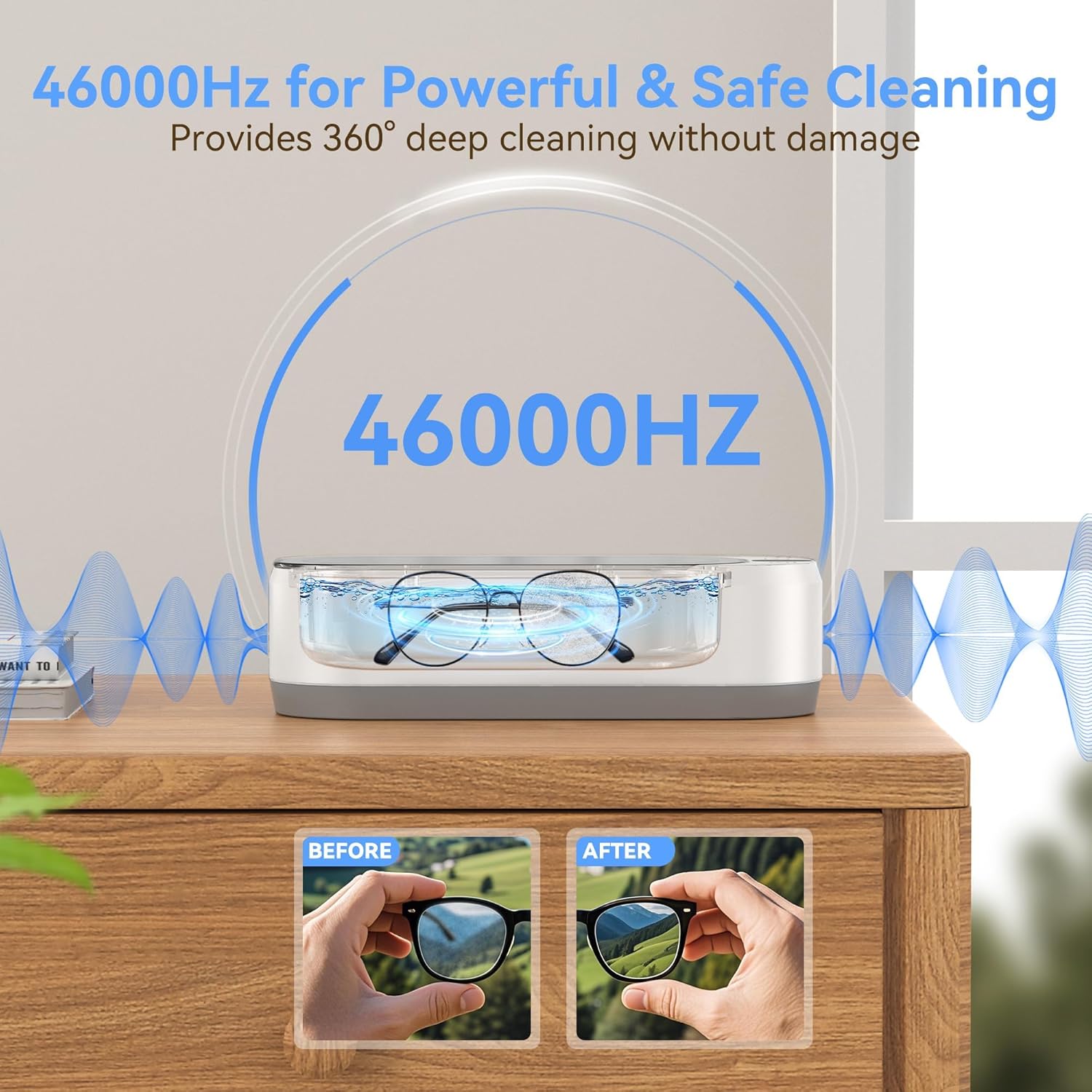
Ultrasonic cleaners use high-frequency sound waves — vibrations far above what human ears can detect — to create millions of microscopic bubbles in a liquid bath. When those bubbles collapse against a surface (a process called cavitation), they dislodge dirt, skin oils, and tarnish without brushes or scrubbing. At the sub-$50 price tier, you’ll find a crowd of nearly identical-looking plastic tanks, mostly 600 mL to 750 mL, clustered around 40 kHz (kilohertz — a measure of how many vibration cycles happen per second), and rated for jewelry and eyeglasses on the box. The problem is that “good enough for jewelry” covers a wide range of outcomes, and the wrong frequency or an undersized tank can leave delicate gemstones or plastic lens coatings worse than when you started. This guide explains the two decisions that actually matter — frequency and tank volume — and gives you a clear rule for which box to take home.
| EDITOR'S PICK[Magnasonic Ultrasonic Cleaner -…](https://www.amazon.com/dp/B007Q2M17K?tag=greenflower20-20) | Mid-tier[Ukoke UUC06S Ultrasonic Cleaner](https://www.amazon.com/dp/B074J8VSC5?tag=greenflower20-20) | Budget pick[BEESHOP 48kHz Ultrasonic Jewelr…](https://www.amazon.com/dp/B0F1FW4MPB?tag=greenflower20-20) | |
|---|---|---|---|
| Tank material | Stainless Steel | Stainless Steel | 304 Stainless Steel |
| Tank capacity | 20oz | 600ml | 19oz |
| Frequency | — | 42kHz | 48kHz |
| No. of modes | 5 | — | Dual |
| Timed cleaning | Digital Timer | — | — |
| Price | $39.99 | $21.46 | $19.99 |
| See on Amazon → | See on Amazon → | See on Amazon → |
Why Frequency Is the First Number to Check
Frequency determines the size of the cavitation bubbles your cleaner generates, and bubble size determines what gets cleaned — and what gets damaged.
Lower frequency (28 kHz): Produces larger, more energetic bubbles. These are powerful enough to strip heavy contamination — carbonized oils, machined-metal chips, carbon fouling on firearm parts. At this energy level, they are also aggressive enough to damage soft gemstones (opal, pearl, emerald, turquoise), loosen pavé-set stones, and abrade anti-reflective coatings on eyeglass lenses. Per Cole-Parmer’s Ultrasonic Cleaner Selection Guide, 28 kHz is the standard recommendation for industrial metal parts, not for optical or gem-set pieces.
40 kHz: The sweet spot for light-duty consumer applications. Smaller bubbles mean gentler cavitation — enough to lift skin oils and soap film from gold, platinum, diamond, and titanium frames without attacking surfaces. Across the sub-$50 category, 40 kHz is essentially universal; almost every unit in this price band is spec’d at or near this frequency. Grainger’s Ultrasonic Cleaner Specifications Catalog lists 40 kHz as the minimum recommended frequency for optical components and jewelry with hard faceted stones.
80 kHz and above: Finer still — ideal for soft metals, delicate plating, and high-precision optics. You will not find 80 kHz at sub-$50. It requires more sophisticated transducer arrays and tighter manufacturing tolerances. This is the Elma and Branson BRANSONIC territory, starting well above $300.
The practical decision for the under-$50 buyer: If your use case is diamond rings, gold chains, titanium or stainless steel eyeglass frames, and hard-faceted sapphire or ruby jewelry, 40 kHz works. If you own pieces with soft or porous stones — pearls, opals, emeralds, turquoise, or any coral — no sub-$50 machine is appropriate. Jewelers of America’s Jewelry Care and Cleaning Technical Bulletin is explicit: ultrasonic cleaning is contraindicated for any porous, treated, or fracture-filled gemstone, regardless of frequency.
Tank Size: The Number Buyers Consistently Underestimate
The volume printed on the box is the total tank capacity — not the usable working volume. Subtract for the basket and required fluid clearance, and the math shrinks fast.
By the numbers — typical 600 mL tank at the sub-$50 tier:
| Stated volume | Basket displacement | Minimum fluid headroom | Usable working volume |
|---|---|---|---|
| 600 mL | ~80–100 mL | ~50 mL (transducer protection) | ~450–470 mL |
That 450 mL working volume sounds fine until you try to clean a wide men’s bracelet, a multi-link watch band, or a large pair of full-rim eyeglass frames. Items must be fully submerged with clearance on all sides to cavitate evenly; resting a piece against the tank wall or basket edge creates a dead zone and can cause localized vibration stress. Popular Mechanics’ Best Ultrasonic Cleaners editorial review (2025) flags tank overcrowding as the most common operator error at the entry level — owners consistently report uneven cleaning and occasional surface marks when pieces touch the basket walls.
Practical size guidance:
- Stud earrings, rings, small pendants, contact lens cases: 600 mL is legitimate. These are small items with room to spare.
- Full eyeglass frames (especially larger men’s or wraparound styles): Measure the frame width. Most sub-$50 tanks have an interior width of roughly 100–115 mm. Many adult frames run 130–145 mm across. A frame that has to angle diagonally in the basket cavitates unevenly on the corners.
- Bracelets, watch bands, necklaces over 18 inches: Folding or coiling a piece in the basket concentrates links against each other. You want a tank where the piece lies flat with 10+ mm clearance on all sides. That typically requires a 1.2 L or larger interior — above the sub-$50 ceiling on most units.
The honest framing here: most buyers in this category are cleaning rings, small pendants, and single pairs of glasses. For that use case, the standard 600–750 mL tank is genuinely sufficient. The mistake is buying the same unit expecting it to handle larger or more varied workloads.
Features That Sound Useful but Don’t Change the Decision at This Price
Digital timers vs. analog knobs: Every sub-$50 unit offers between 90 seconds and 8 minutes of run time. The timer format (LED display vs. dial) doesn’t affect cleaning performance. Most jewelry pieces are clean in 2–4 minutes at 40 kHz with a dilute cleaning solution; the Crest Ultrasonics Frequency Selection Guide notes that extended run times beyond 5 minutes at high energy levels can stress certain stone settings — another reason to avoid leaving pieces running unattended regardless of timer type.
Heating elements: A small number of sub-$50 units advertise a heating function, typically rated to warm solution to 40–50°C. Warmer solution does improve cleaning efficiency (lower surface tension, more active cavitation). However, Cole-Parmer’s selection documentation notes that tank heaters at this price point are typically resistive elements with minimal thermal regulation — they heat the bath slowly and inconsistently. For eyeglass frames with plastic acetate components or resin-filled stones, any uncontrolled heat is a risk. Owners of budget units with heating elements report wide variation in actual solution temperature. If heating matters to your workflow, it’s a reason to move up to a unit with a calibrated thermostat — not a reason to pay a $5–$10 premium for a poorly regulated heater at the sub-$50 level.
“Sweep” frequency labeling: Some listings claim “sweep technology” or “variable frequency.” At this price, treat these as marketing language unless the spec sheet shows actual sweep bandwidth (typically ±2–5 kHz around center frequency). Legitimate sweep improves uniformity by preventing standing-wave dead zones, but it requires active driver electronics that don’t exist in $30–$50 tanks. Grainger’s catalog and Cole-Parmer’s documentation both restrict sweep-mode specifications to mid-tier and above.
Cleaning Solution: The Variable That Outlasts the Hardware
The machine is almost irrelevant if the solution is wrong. At 40 kHz, the cavitation energy is mild enough that the cleaning chemistry does most of the heavy lifting. Two rules that hold across all sub-$50 applications:
-
Dilute dish soap (1–2 drops per 500 mL of distilled water) is a legitimate and safe starting point for gold, platinum, and diamond. Jewelers of America’s care bulletin identifies dilute pH-neutral detergent as appropriate for hard-metal fine jewelry.
-
Never use any acid-based jewelry cleaner, ammonia, or undiluted commercial concentrate in a consumer tank. The plastic housings and transducer bonding adhesives in sub-$50 units are not rated for aggressive chemistry. Owners consistently report tank clouding and seal degradation after repeated use of concentrated solutions — not a safety catastrophe, but it shortens the unit’s already modest service life.
For eyeglasses specifically: lens manufacturers including Essilor and Zeiss publish care guidance (available on their brand documentation pages) recommending only water or dilute optical cleaning solution for coated lenses. Surfactant concentrations that are safe for metal jewelry can strip anti-reflective coatings over repeated cycles at 40 kHz.
The Decision Rule
If your cleaning workload is: rings, small pendants, studs, and standard eyeglass frames with hard-metal construction and diamond or corundum (ruby/sapphire) stones — a 40 kHz, 600–750 mL unit at $30–$50 is legitimate equipment. You are not buying a compromise; you are buying the correct frequency for the application.
If your workload includes: pearls, opals, emeralds, fracture-filled stones, heavily pavé-set pieces, or acetate eyeglass frames — don’t buy in this tier at all. The risk of damage is real, and no budget tank addresses it. The Jewelers of America bulletin recommends hand-cleaning with a soft brush for any of these materials.
If your workload includes: larger bracelets, full watch bands, or oversized frame sizes over 135 mm — measure your interior tank dimensions before purchasing. A $45 unit with a 120 mm interior tank is not the same product as a $45 unit with a 140 mm interior. This information is usually in the listing’s product dimensions, not the marketing copy.
If you’re buying for a small jewelry business or eyeglass-repair counter and expect daily cycles: this tier will show wear within 6–18 months of regular use based on aggregated owner reports. The cost-per-cycle math at that volume favors stepping up to an iSonic D3800A or equivalent mid-tier unit at $150–$200, where transducer longevity and tank construction are meaningfully better per published spec documentation from iSonic’s commercial line.
The sub-$50 category does what it says for the right use case. The tradeoffs aren’t hidden — they’re just not on the box.