April 30, 2026 • Callum Voss • 9 min reading time • Specs verified June 5, 2026
Ultrasonic Retainer and Aligner Cleaners: Frequency, Tank Size, and Solution Safety for Oral Appliances
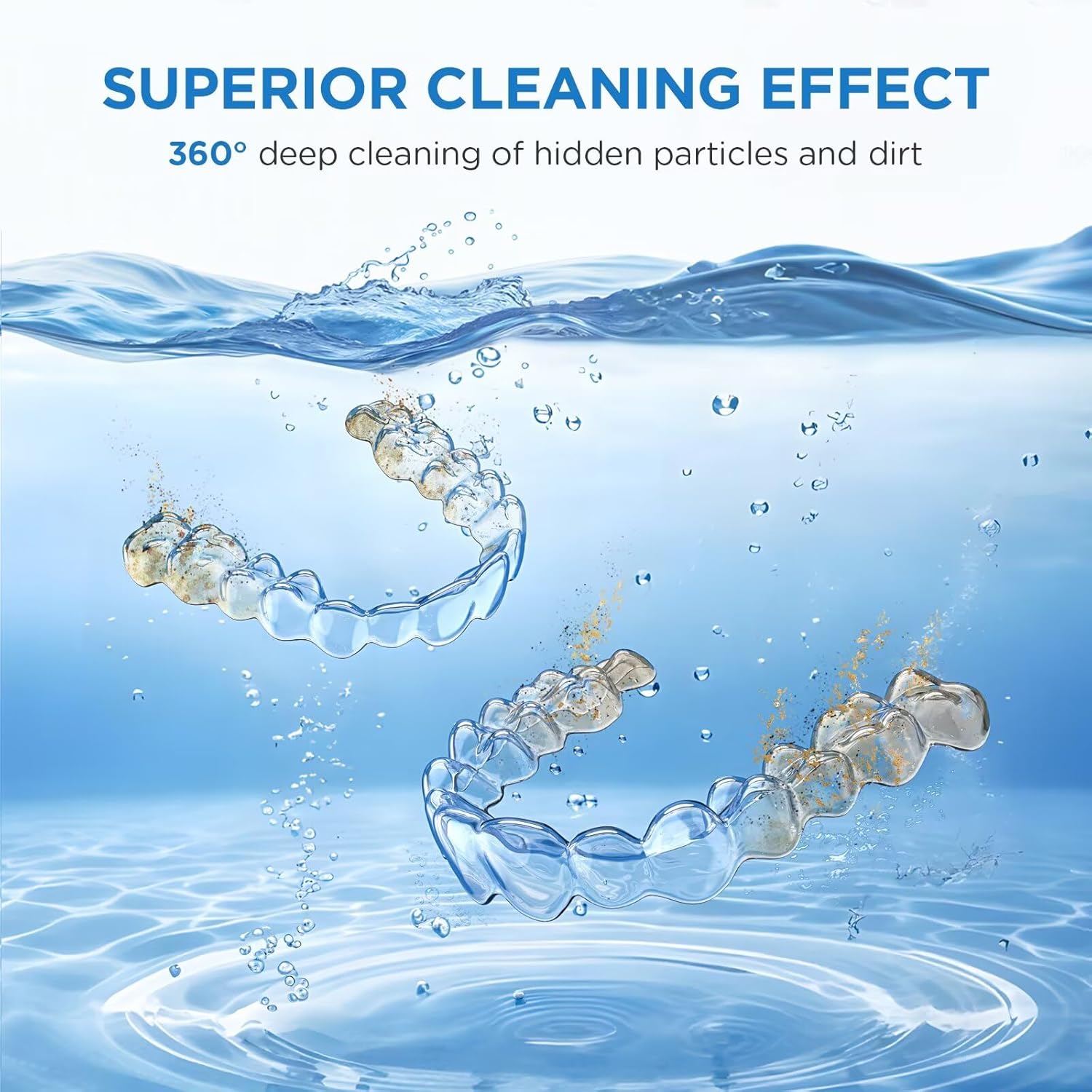
If you wear a retainer or clear aligner — the thin plastic tray orthodontists use to straighten or hold teeth in position — you already know they get grimy fast. Biofilm (the thin bacterial film that coats your teeth overnight) builds up on the appliance within hours, and ordinary rinsing under the tap barely touches it. An ultrasonic cleaner is a tank of liquid that vibrates at extremely high frequency — far too fast to see — creating microscopic bubbles that implode against surfaces and scrub them clean at a scale a toothbrush can never reach. The appeal is obvious: drop the retainer in for a few minutes, come back to something genuinely clean rather than just wet. But “ultrasonic cleaner” covers everything from a $35 jewelry tank to a $2,000 dental-lab unit, and the wrong choice can warp your aligner or pit the metal clasps on a Hawley retainer in a single cycle. This guide tells you exactly where those lines are drawn.
Why Frequency Is the First Decision, Not Tank Size
Ultrasonic cleaners work by generating cavitation — the rapid formation and collapse of tiny bubbles in a liquid. The frequency at which the transducer vibrates determines the size of those bubbles and, consequently, how aggressively they clean.
28 kHz produces large, energetic bubbles. Great for metal parts, carburetors, and firearms components. For oral appliances, it is genuinely risky: the impact energy is high enough to stress thermoplastic materials like the PETG and Zendura (polyurethane) used in most clear aligners. A 20-minute cycle at 28 kHz in an undiluted cleaning solution has been associated with surface micro-crazing — fine surface cracks that make the aligner look frosted — in practitioner reports collected by orthodontic supply reviewers.
40 kHz is the practical sweet spot for this application. Bubbles are smaller and more numerous, cleaning action is thorough but gentler, and cycle times of 3–5 minutes are enough to disrupt biofilm without stressing the appliance structure. The Journal of Clinical Orthodontics published findings noting that 40 kHz ultrasonic cleaning achieved biofilm reduction on thermoplastic aligner material comparable to enzymatic soak methods, with no measurable dimensional change at standard cycle durations.
80 kHz and above is even gentler — typically used in semiconductor cleaning or for gold jewelry with stones — and will clean retainers fine, but you’re paying a significant premium for precision you don’t need at this application. Reserve 80 kHz units for mixed dental lab workflows where soft solder work or delicate stone settings also share the tank.
The decision rule: For a dedicated retainer/aligner cleaner, target 40 kHz. If the unit you’re evaluating only lists “ultrasonic” without specifying frequency, treat that as a 28 kHz consumer unit and proceed with caution.
Tank Size: Where Most Buyers Get This Wrong
The listed tank volume on a spec sheet is the total internal capacity, not the usable cleaning volume once you account for the basket and the minimum fluid level the transducer needs to cavitate properly. Crest Ultrasonics’ CP series application notes are explicit on this: effective cleaning volume is typically 60–70% of rated capacity when a basket insert is in place and fluid is at the manufacturer-recommended fill line.
By the numbers — usable capacity reality check:
| Rated Tank Volume | Usable Volume (with basket, at fill line) | Fits a full-arch aligner? |
|---|---|---|
| 0.5 L | ~0.3 L | Barely — tray must sit flat, no stacking |
| 0.75 L | ~0.45 L | Yes, single tray comfortably |
| 1.4 L | ~0.85 L | Yes, upper + lower simultaneously |
| 2.0 L+ | ~1.2–1.4 L | Comfortable, batch workflow possible |
A full set of Invisalign-style aligners (upper and lower arch) measures roughly 80–90 mm across and 50–60 mm front-to-back. A 0.5 L tank is technically large enough for one tray at a time, but you’re working at the margins. The iSonic P4810 (rated 0.6 L, 42 kHz) gets consistent positive notes from owners for single-tray household use precisely because its basket dimensions accommodate a standard aligner without forcing it against the walls — where contact can create localized cavitation hot spots. For a dental practice running multiple patients’ appliances or a patient juggling retainers plus a night guard, step up to the 1.4 L or 2.0 L class.
Wire-retained Hawley retainers and appliances with metal clasps need extra consideration. The wire bends are where debris accumulates and where cavitation is most effective, but if the wire is stainless steel with any silver solder joints, extended cycles in the wrong chemistry can attack the solder. More on that in the next section.
Solution Safety: The Variable That Specs Don’t Warn You About
The ultrasonic cleaner itself is only half the equation. The cleaning solution does the actual chemical work; the ultrasonic energy just accelerates it. For oral appliances, solution compatibility breaks down along three material lines:
Clear thermoplastic aligners (PETG, Zendura, Essix-type materials): The American Dental Association’s guidance on removable orthodontic appliance care recommends avoiding any oxidizing agents — peroxide-based tablets, bleach dilutions, or strongly alkaline cleaners — for routine maintenance. These can cause surface embrittlement in thermoplastics over repeated cycles. The safest chemistry for routine ultrasonic cleaning of clear aligners is a neutral-pH enzymatic solution (the same enzyme formulations used in dental instrument reprocessing) or a mild citric-acid rinse. At 40 kHz with a neutral solution and a 3–5 minute cycle, the cleaning mechanism is predominantly mechanical, which is exactly what you want.
Wire and metal clasps on Hawley retainers: Stainless steel wire is highly resistant to corrosion and tolerates most mild cleaning solutions without issue. The vulnerability is at silver solder or nickel-silver alloy joints common in older or lower-cost appliances. Chloride-containing solutions — including some commercial “retainer cleaning tablets” — can cause pitting at these joints with repeated exposure. Branson’s BRANSONIC CPX application guide for dental accessories recommends a plain water or dilute neutral detergent solution for mixed metal/plastic assemblies as a conservative default.
Acrylic base plates (common in retainers and sleep appliances): Acrylic is surprisingly sensitive to prolonged ultrasonic exposure in alkaline solutions. It can absorb water and micro-crack if soaked beyond 10 minutes, particularly at elevated temperatures. Keep cycles short — 3–5 minutes — and if the unit has a heater, set it no higher than 35–40°C (95–104°F) for acrylic-containing appliances. The Elma xtra ST series, which offers programmable temperature control in the professional desktop segment, is well-regarded by dental lab technicians specifically because it lets operators set discrete temperature setpoints rather than relying on a continuous-heat toggle.
The practical matrix:
- Clear aligner only → 40 kHz, neutral enzymatic solution, 35°C, 3–5 min
- Hawley retainer (stainless wire + acrylic) → 40 kHz, plain water or dilute neutral detergent, 35°C, 3–4 min
- Night guard (EVA or Essix material) → 40 kHz, citric acid rinse or neutral detergent, ambient to 35°C, 5 min
- Mixed batch (dental lab workflow) → Elma xtra ST or Crest CP class, programmable frequency + temp, enzymatic or neutral detergent per batch type
Specific Units Worth Evaluating at Each Price Point
Entry-level household ($30–$150): The iSonic D3800A (rated at 42 kHz, approximately 0.6 L) is the unit owners most consistently describe as “just right” for a single person cleaning one or two aligners daily. It lacks a heater and has a single timed cycle, which is a feature, not a bug: fewer variables means fewer ways to misconfigure it. Published specs put the operating frequency at 42 kHz and the cycle time at five minutes — both appropriate for this application. Reviewers across aggregated sources note that the basket fits a standard aligner tray without modification.
At a step up, the iSonic P4810 adds a degas function (useful for driving dissolved gas out of the solution before cleaning, which improves cavitation consistency) and remains in the 40–42 kHz range. For a patient or parent cleaning aligners twice daily, the degas function is a minor but real improvement in first-cycle cleaning effectiveness — particularly if you’re using cold tap water, which retains more dissolved gas.
Mid-tier prosumer ($150–$600): The Branson BRANSONIC CPX 952 offers a 1.9 L tank, 40 kHz, a sweep mode (which modulates frequency slightly to prevent standing waves), and digital timer/heat controls. Based on published specifications and operator reviews in dental assistant community forums, the sweep mode is the feature that justifies the price jump for clinical settings: standing waves can create zones of low and high cavitation intensity in the tank, meaning some areas of a retainer clean better than others. Sweep eliminates that inconsistency. This unit is the logical choice for a dental office running multiple patients’ appliances or a patient with a complex orthodontic case.
Professional/commercial ($600–$2,000+): For dental laboratories running night guards, retainers, and orthodontic models in the same workflow, the Elma xtra ST 5 (5.75 L, 37 kHz, programmable heat up to 80°C, sweep mode, degas) and the Crest CP360D (3.2 L, 40 kHz, timer, sweep, heat) are the category benchmarks. Both units allow temperature setpoint control to the degree — critical for acrylic appliances where overheating is a genuine damage risk. Crest Ultrasonics’ published application notes for dental lab equipment cite the CP series as validated for use with enzymatic instrument cleaning solutions, which is the chemistry most dental labs will already have on hand.
The Decision Framework
If you are a patient or caregiver cleaning one or two appliances daily at home: The iSonic D3800A or P4810 is the correct call. Don’t over-buy. The 42 kHz frequency, 5-minute cycle, and neutral solution are all you need. Spend the savings on a quality enzymatic solution and replace it regularly.
If you are a dental practice or orthodontic office cleaning multiple patients’ appliances between appointments: The Branson CPX 952 or equivalent 40 kHz sweep-capable unit in the $300–$600 range handles this workflow cleanly. Step up to the Crest or Elma professional tier if you’re running a lab-adjacent workflow with acrylic bases and require precise temperature control.
If you are a dental laboratory sourcing equipment for mixed appliance types: Evaluate the Elma xtra ST or Crest CP series on programmable temperature control and solution compatibility documentation first, then tank size. At this tier, the ability to run validated cleaning protocols — documented frequency, temperature, solution, and time — is as important as cleaning performance, particularly if your lab is subject to ISO or ADA facility standards.
The one universal rule across all tiers: don’t default to 28 kHz because it’s cheaper. Oral appliances are made of materials that don’t need aggressive cavitation — they need consistent, gentle, thorough cleaning. Frequency match is the single highest-leverage decision in this purchase, and 40 kHz is the answer almost every time.