April 18, 2026 • Callum Voss • 10 min reading time • Specs verified June 5, 2026
Commercial-Adjacent Ultrasonic Cleaners 20L and Up: Honest Brand Comparisons for Dental Labs and Small Shops
If you’ve landed here researching a 20-liter (roughly 5-gallon) or larger ultrasonic cleaner, you’re stepping out of the hobbyist tier and into equipment that demands real procurement discipline. An ultrasonic cleaner works by generating high-frequency sound waves — typically between 28,000 and 80,000 cycles per second — inside a liquid-filled tank. Those waves create millions of microscopic bubbles that implode against surfaces, scrubbing contaminants off parts without abrasion. At 20 liters and above, these machines stop being bench accessories and start behaving like production infrastructure: they draw serious power, require plumbed or large-bucket fill routines, and in most small-shop contexts they run for hours at a stretch. This guide compares the three brand families that come up repeatedly in dental lab, watch repair, and small industrial purchasing decisions — Branson BRANSONIC, Crest CP series, and Elma xtra ST — and gives you an honest tradeoff map, not a product parade.
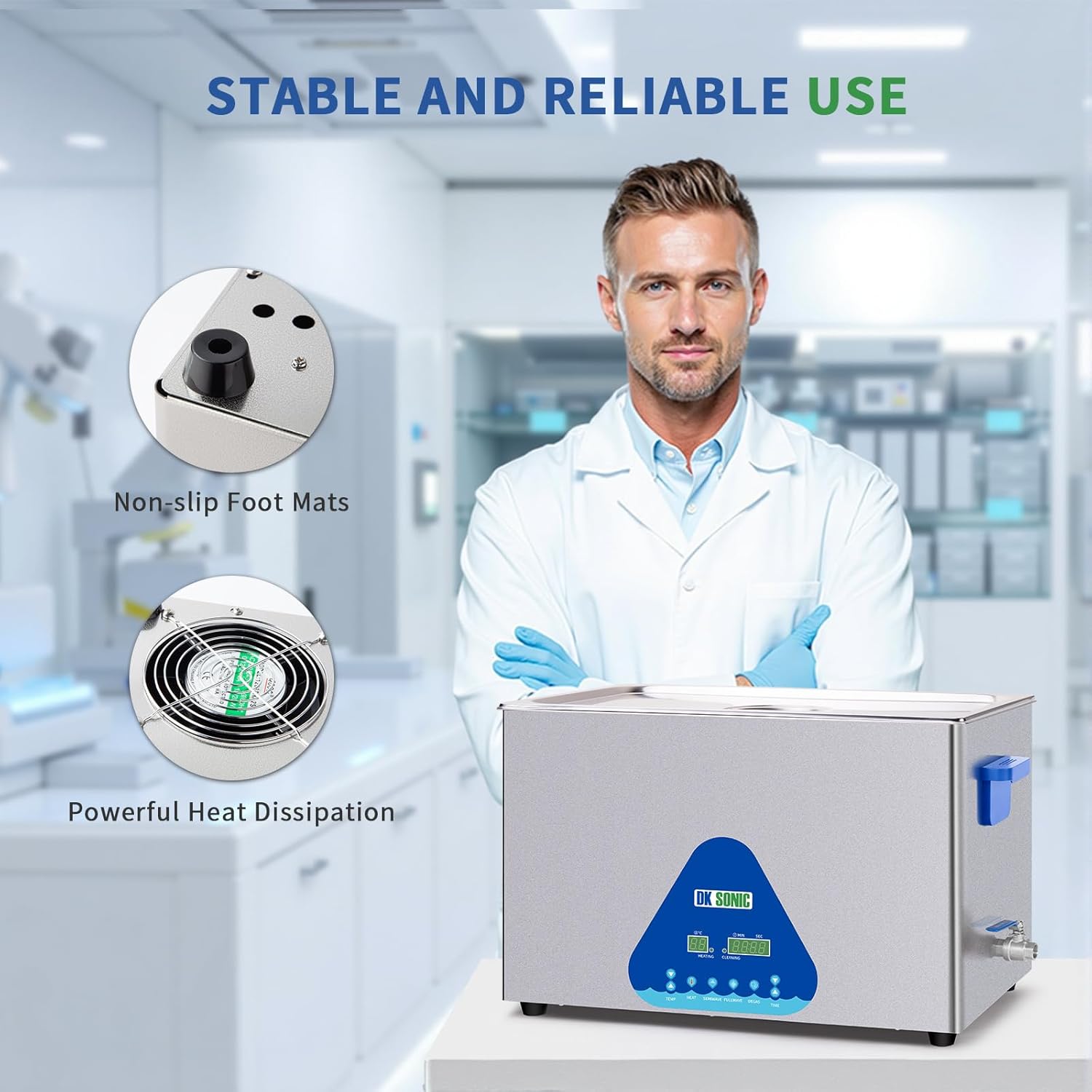
| EDITOR'S PICK[DK SONIC Professional Ultrasoni…](https://www.amazon.com/dp/B0CRNSH58K?tag=greenflower20-20) | Mid-tier[DK SONIC Ultrasonic Cleaner 30L](https://www.amazon.com/dp/B07BGSN6CC?tag=greenflower20-20) | Budget pick[VEVOR 30L Sonic Cleaner](https://www.amazon.com/dp/B0DK8TF69J?tag=greenflower20-20) | |
|---|---|---|---|
| Capacity | 37L | 30L | 30L |
| Power | 720W | 600W | 600W |
| Frequency | — | — | 40kHz |
| Basket included | ✓ | ✓ | — |
| Degassing mode | — | — | ✓ |
| Price | $649.99 | $459.99 | $219.90 |
| See on Amazon → | See on Amazon → | See on Amazon → |
Why 20L Is a Category Inflection Point
Below roughly 10 liters, you’re buying a desktop cleaner. Above 20 liters, the purchase calculus changes on almost every axis.
Physical footprint and workflow integration. A 20L tank typically has an internal basket footprint of around 300 × 240 mm or larger. That’s enough to accommodate dental instrument cassettes, watch movement trays stacked two-deep, or a row of PCB panels. But the unit itself may weigh 25–40 kg unfilled. Installation becomes a logistics question, not just a purchasing one.
Electrical draw. Entry-level units run on a standard 15A circuit. Most 20L-and-up professional units require a dedicated 20A circuit; some Crest and Elma configurations at the top of this range specify 240V service. If your shop isn’t wired for it, add that to your total cost of ownership before comparing prices.
Heating time and temperature stability. A larger thermal mass takes longer to reach operating temperature — commonly 45 to 90 minutes from cold, depending on heater wattage and ambient temperature. Units with higher-wattage heaters (400W and above) close this gap meaningfully. For dental labs running back-to-back instrument batches, this matters operationally.
Transducer array and power density. The relevant figure here is watts per liter of tank volume (ultrasonic power only, not heater). Across published specs reviewed for this article, the professional tier lands between 5 and 10 W/L. Units below 5 W/L tend to underperform on heavily soiled loads; units advertised at suspiciously high W/L figures often reflect peak rather than continuous output. The Crest Ultrasonics CP Series Product Specification Sheets (2025 edition) and the Elma xtra ST Series User and Installation Manual both distinguish between peak and nominal figures — a transparency signal worth noting when comparing competing brands that do not make the same distinction.
Brand-by-Brand Comparison
The three sections below evaluate Branson, Crest, and Elma against the same set of criteria: power density, frequency options, controls and compliance features, service infrastructure, and price positioning. Each section closes with a tier marker reflecting where that brand fits in the purchasing hierarchy for this size class.
Branson BRANSONIC (Emerson Commercial Line)
Branson’s BRANSONIC line is the name most buyers encounter first, partly because Emerson’s distribution network is wide and partly because the brand has decades of institutional presence in lab and industrial settings. The commercial-adjacent units in the 20L+ range — notably the BRANSONIC CPX and larger BRANSONIC series configured with external generators — are specified at 40 kHz as a standard frequency. That 40 kHz sweet spot is a reasonable general-purpose choice: aggressive enough for dense contamination on stainless steel instrument sets, gentle enough that operators in dental and watchmaking contexts report acceptable results on most substrates when paired with appropriate chemistry.
Where Branson earns consistent praise in long-run operator accounts is reliability and parts availability. Because the brand has such wide institutional adoption, replacement transducers and generator boards are easier to source than for some competitors. Operators in dental sterilization workflows note that the digital timers and temperature readouts on current BRANSONIC commercial models are straightforward to calibrate for compliance documentation — relevant if your lab is subject to periodic instrument-reprocessing audits. The Branson Ultrasonics BRANSONIC Professional Series Technical Reference Guide details the calibration procedure and the tolerance bands required for documentation purposes.
The tradeoff: Branson’s published ultrasonic power figures in the 20L commercial range are competitive but not class-leading on power density. The BRANSONIC design philosophy leans toward consistency and robustness over aggressive cavitation output. If your application involves heavy carbon deposits, baked-on investment material, or bulk industrial degreasing, that conservative approach may mean longer cycle times compared to Crest at equivalent tank volume.
Price positioning (mid-2026): New BRANSONIC commercial units in the 20–30L class typically land in the $1,400–$2,200 range through authorized distributors, depending on configuration (digital controls, heated vs. unheated, sweep mode inclusion). Grainger carries select BRANSONIC SKUs with published list pricing that provides a useful benchmark for distributor negotiation.
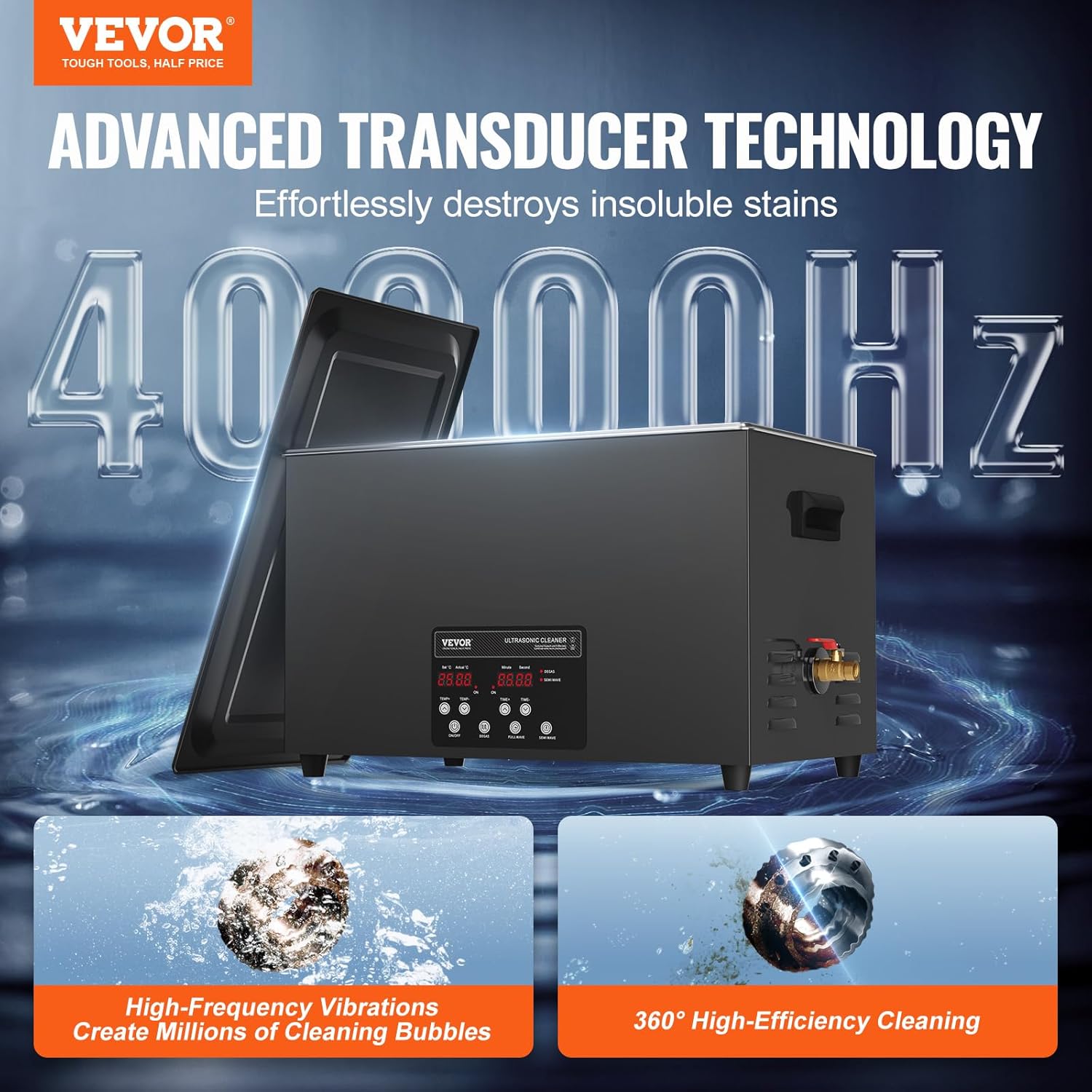
VEVOR
$219.90
In stock on Amazon
Check price on AmazonCrest CP Series
Crest Ultrasonics is arguably the most specification-transparent brand in this category. The Crest Ultrasonics CP Series Product Specification Sheets — available directly from Crest and through distributors including Grainger-stocked SKUs — publish nominal ultrasonic wattage, tank dimensions, basket clearances, and frequency tolerances in a format that makes side-by-side comparison straightforward. That transparency is itself useful data: it suggests a company accustomed to procurement-level scrutiny.
The CP series offers models across 28 kHz, 40 kHz, and in some configurations 80 kHz. For small shops handling a mixed workload — firearms components one week, dental instruments the next — the 28 kHz option is worth serious consideration. Lower frequency produces larger cavitation bubbles with more mechanical energy per implosion, making it more effective on robust metal parts with heavy fouling. Operators in machine shop and firearms cleaning contexts who have documented their Crest CP usage consistently note the 28 kHz models outperform 40 kHz alternatives on carbon and solvent-resistant deposits.
Crest’s heated CP models in the 20L range typically spec at 300–500W of heating power, with digital temperature control accurate to ±1–2°C per the CP Series Product Specification Sheets. Degassing cycles — a feature that expels dissolved air from fresh solution to establish effective cavitation faster — are standard on most CP commercial models, not an add-on. For a dental lab drawing fresh deionized water regularly, that matters operationally.
By the numbers — Crest CP Series 20L reference configuration:
- Ultrasonic power (nominal): ~120–180W depending on model
- Heater: 300–500W
- Operating frequency: 28 or 40 kHz (model-specific)
- Temperature range: ambient to 80°C
- New price range (mid-2026, distributor pricing): $1,600–$2,600
The weakness Crest buyers should plan for: lead times. Crest manufactures to order for many configurations, and several distributors report 4–8 week lead times on non-stocked CP series units as of early 2026. If you need a unit in two weeks, that is a real constraint. The Cole-Parmer Ultrasonic Cleaner Buyer’s Guide (available at coleparmer.com) lists Crest CP among its recommended commercial-tier options and notes that specification transparency is a distinguishing feature of the line.
DK
$459.99
In stock on Amazon
Check price on AmazonElma xtra ST Series
Elma is the European-origin brand least familiar to American buyers but increasingly present in U.S. dental and watchmaking procurement. The xtra ST series is Elma’s commercial-facing line, and it distinguishes itself primarily on two axes: sweep frequency modulation and build quality at the tank and basket level.
Sweep — sometimes called “frequency sweep” or “wobble” — is a feature that continuously varies the ultrasonic frequency within a narrow band around the rated frequency (for example, 40 kHz ± 2–3 kHz). The practical effect is a more uniform cavitation field across the tank, reducing “dead zones” where standing waves would otherwise create spots with less cleaning energy. For applications like dental instrument reprocessing, where you may have 20–30 individual instruments arranged across a basket, uniform cleaning coverage matters more than peak power. The Elma xtra ST Series User and Installation Manual specifies sweep as standard on commercial models; it is an add-on or absent entirely on many competing platforms at equivalent price points.
The xtra ST series tanks are specified with stainless steel construction meeting standards relevant to European medical device processing environments. Operators in European dental labs and, increasingly, American labs sourcing through importers describe basket-to-tank fit tolerances as notably tight — a detail that sounds minor but matters when you’re trying to maximize usable depth while maintaining the recommended fluid clearance above the basket, which the Elma xtra ST User and Installation Manual specifies at 25–40mm.
Price positioning: Elma xtra ST 20L+ units run $1,800–$2,800 through U.S. importers, sometimes more. Import lead times and the importer’s inventory position add variability. The Cole-Parmer Ultrasonic Cleaner Buyer’s Guide notes that pricing for European-manufactured commercial ultrasonic equipment reflects manufacturing cost structures that differ from domestic producers — this is not a unit where you will find aggressive discounting.
The tradeoff: service and parts. Branson’s domestic parts network is meaningfully larger. For a high-volume dental lab or production shop where downtime is expensive, factor service access into the decision, not just purchase price.
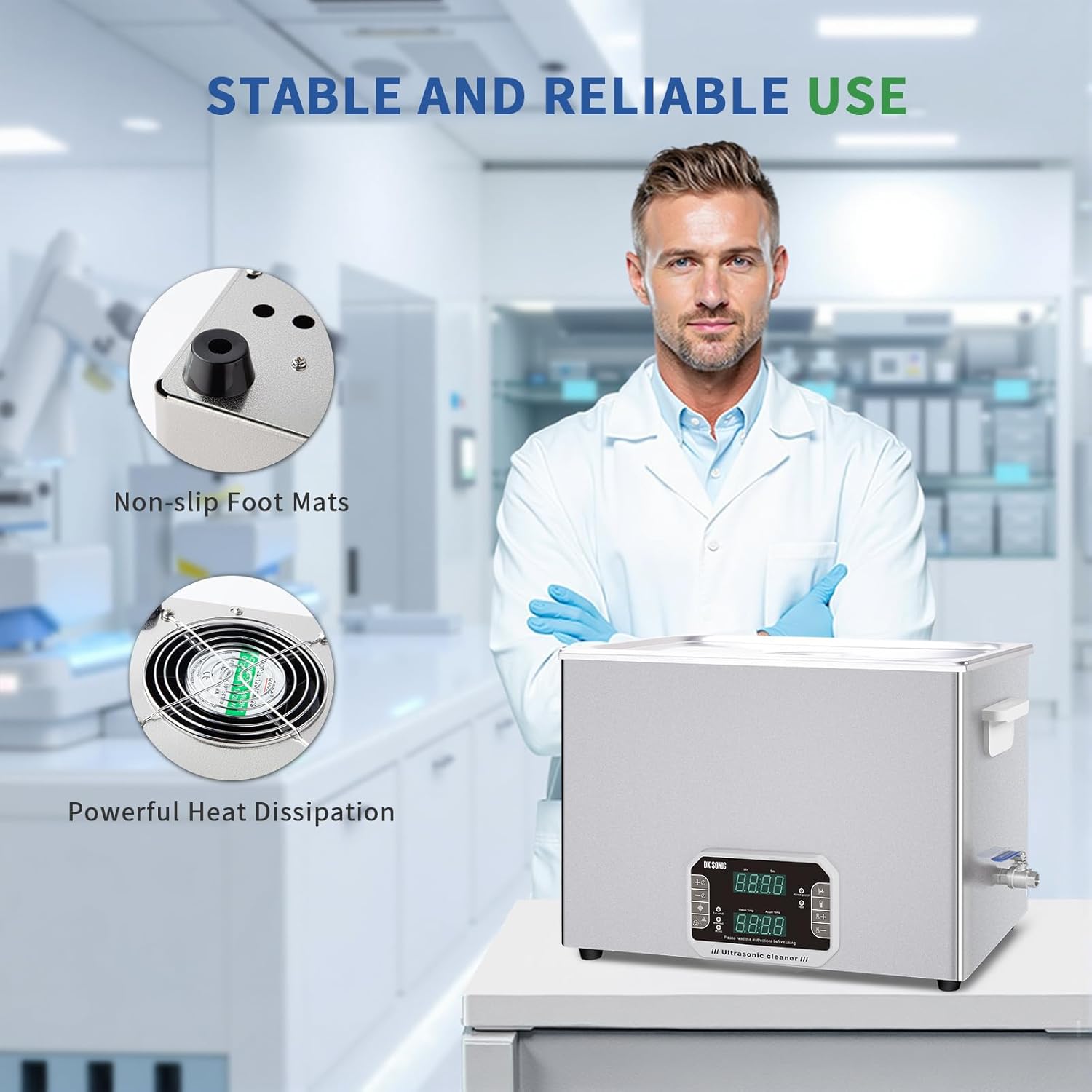
DK
$649.99
In stock on Amazon
Check price on AmazonDecision Framework: Matching Application to Brand
After mapping the specs and operator patterns across these three lines, here is the clearest decision logic for the 20L+ commercial-adjacent buyer.
If your primary workload is dental instrument reprocessing with back-to-back cassette batches: Elma xtra ST is the strongest match. Sweep coverage, basin quality, and the thermal stability documented in the xtra ST specs align with the uniformity demands of instrument reprocessing. The price premium is real; so is the application fit.
If you need frequency flexibility across a mixed workload (firearms, industrial parts, some dental or optical): Crest CP series, configured at 28 kHz, gives you the most power-per-dollar at the specification level and the most transparent data to defend the purchase internally. Plan for lead time.
If service continuity and parts availability are non-negotiable constraints — you’re in a production environment where a week of downtime has hard costs — Branson BRANSONIC wins on ecosystem depth. The cavitation output isn’t class-leading, but the reliability track record and domestic service infrastructure are documented advantages that matter in that context.
If your budget ceiling is firm around $1,400–$1,600 new: Branson is likely your only realistic new-unit option in this size class from a major brand. Crest and Elma both push above that ceiling in 20L configurations. The alternative worth researching is the refurbished market for Crest CP units — units returned from lab closures or equipment refreshes sometimes surface through industrial resellers and the Cole-Parmer used equipment listings at 40–60% of new price, often with remaining transducer life.
One More Variable: Solution Chemistry
None of the hardware comparisons above mean much if the cleaning solution chemistry is wrong for your substrate. The Branson BRANSONIC Professional Series Technical Reference Guide, Crest’s application notes included with the CP Series Specification Sheets, and IPC-7711/7721 — the electronics industry’s rework and cleaning standard published by IPC (ipc.org) — all flag the same consistent risk: alkaline solutions optimized for steel instruments can damage aluminum components, brass fittings, and some plated surfaces. At 20L, you’re running larger batches. Mistakes scale.
Before you finalize any unit purchase, confirm that your intended solution chemistry is listed as compatible in the manufacturer’s documentation, and cross-reference against the substrate sensitivity guidance in the Elma xtra ST User and Installation Manual, which includes one of the more detailed compatibility matrices available in this category.
The right unit at the wrong chemistry setting is still the wrong setup. That is not a caveat — it is the next research task once you have made the hardware call.